Latsei
The Reincarnationist PapersLatsei is the village Bando calls home and the place of his first family. Its return to the narrative is both a homecoming and a rupture: Bando recognizes the landscape and its people, but the community does not recognize him as one of its own. The village becomes the setting for a brief, fragile reunion that ends in violence and Bando’s fall from a bluff; a note appended to the narrative also leaves Latsei’s historical identity unresolved.
Identity and Setting
Bando names Latsei as the place of his first family, but the name first reaches Juan through a story told in a language Juan cannot understand. Juan knows thirteen languages and has heard more than fifty others across many lands, including among the peoples and caravans of the silk, spice, and African trade routes. Bando’s language is nevertheless entirely unfamiliar to him. When Juan asks for the story in Portuguese, Bando cannot translate it. Latsei is therefore introduced not through a shared map or a common account, but through Bando’s memory and the limits of Juan’s understanding.
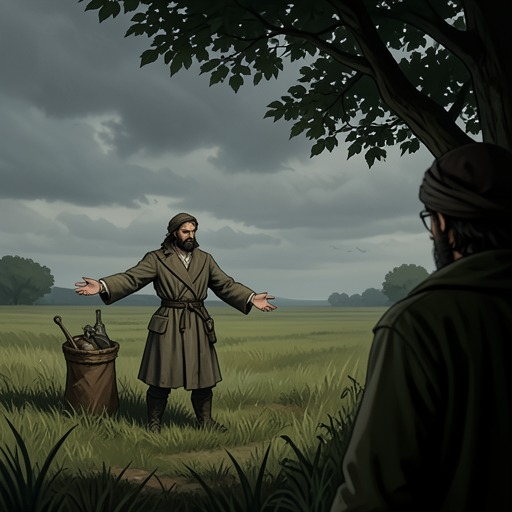
The route to the village passes a small lake ringed with white salt. Dark footprints mark the crust along its bank. Bando suddenly recognizes the place and rides toward it at full speed, nearly throwing himself into the water when his horse stops at the edge. He emerges laughing and shouting, while Juan, initially amused, cannot tell what has brought on the reaction. The lake’s traces of earlier passage make it a threshold in the journey: Bando reads the landscape as familiar before Juan can know why it matters.
The Village and Bando’s Return
Bando describes the destination as a city in the rocks. The settlement comes into view at the base of a sandstone bluff: about thirty buildings of varying sizes are fitted one above another, forming a three-tiered arrangement of stone walls and ladders beneath a great overhanging mass of rock. Bando stops, dismounts, and identifies it as his home. His voice cracks as he says so.
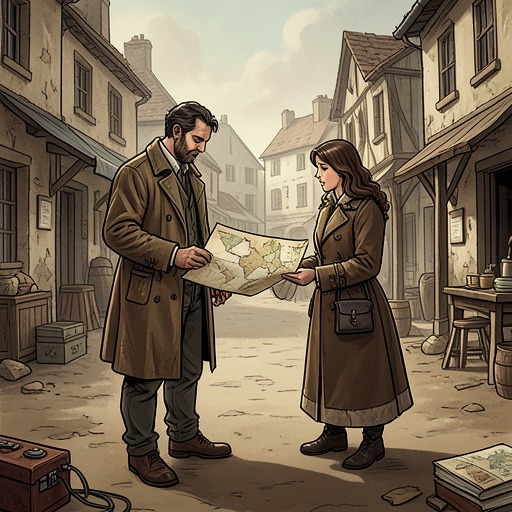
The approach is marked by the difference between the two travelers. Juan wears a breastplate bought in Compostela, ill-fitting armor made for a taller, heavier man. He has worn it only a few times, including before Hawikuh, and now adjusts its straps as they near the village. Bando asks that they leave the horses behind and walk. The settlement has already noticed them: roughly fifty or sixty people gather near the compound. As Bando approaches, they form a semicircle around him. Children touch his skin and retreat giggling; older children and some women reach toward his hair and lips. He is visibly moved, and his tears make the distance between homecoming and recognition painfully immediate.
Recognition, Fear, and Violence
The gathering does not share Bando’s understanding of the return. Speaking in the village’s language, he tries to reassure the people, but a chief calls him Masaudu of the underworld and points to his skin as proof. The villagers’ curiosity gives way to fear and hostility. Bando has arrived at the place he remembers as home, yet the first public explanation of his presence casts him as an otherworldly threat.
The chief later tells Bando that he understands why he has returned. Bando answers through action as much as speech: he came for his soul, not the chief’s. As the chief lies dying, he offers his own life and begins to ask Bando to spare the others, but cannot finish. Juan cradles him and wishes he could understand his last words. The chief dies after meeting Juan’s eyes and smiling. Juan folds his arms across the man’s chest, straightens his robe, and leaves the silent village for Bando’s shop, where Bando works feverishly, repeatedly putting down and retrieving his tools.
The danger returns when a group closes around the shop. Juan draws his sword and prepares to fight rather than let the villagers take Bando. As Bando emerges, two men hold his arms; he breaks free, falls among the crowd, and is struck with a club above his left eye. Kicked and beaten, he calls for Teszin. Juan’s charge, sword raised, interrupts the attack long enough for Bando to crawl away along the outside wall. The village has become not only the destination of Bando’s return but also the place where his remembered ties cannot protect him from the crowd.
The Bluff and the Uncertain Record
At the edge of the bluff, Bando stands bloodied, with his shirt torn away. Teszin calls to him, but Bando looks instead toward Juan, who still holds a large silver necklace partly draped around an old woman’s neck. Juan asks whether Bando is ready. Bando closes his eyes and pitches forward from his perch. Juan sees him remain aloft for an instant, graceful enough to seem almost capable of flight, before beginning his descent. Teszin’s scream carries beyond the impact. The scene closes Bando’s return at the village’s defining landform, turning the bluff above his home into the site of his fall.
The appended note cautions that Latsei’s name is a mystery: no record of a pueblo or people of that name exists in the region. It suggests that the name could be a corruption of Zia, a historic village northwest of Albuquerque, but explicitly presents that possibility as speculation. That uncertainty limits what can be claimed about Latsei as a historical place. Within the narrative, however, its significance is concrete: it is Bando’s remembered first home, a landscape he recognizes in fragments, and a community whose response to his return moves from touch and curiosity to fear and fatal violence.